
What are the different types of headstones?
Headstones are usually grouped by how they sit on the grave.
- Flat markers lie level with the lawn. They are also called flush markers.
- Bevel markers are low blocks, a little taller at the back than the front.
- Slant markers have a face cut at an angle, so the words tilt up toward you.
- Upright headstones stand on a base. This is the stone most people picture.
- Companion, or double, headstones are made for two people.
- Hearts, benches, pet stones and cremation memorials are made for a particular person or a particular kind of burial.
The cemetery decides which of these it allows, often section by section. So the kindest first step is to ask the cemetery office for its rules, then choose the type you love from the ones allowed.
Customize your headstone now
Type a name and see it on the stone. Free, no account.

Stone
The full designer adds symbols, lettering styles, sizes in inches and a link to send to your monument company.
Headstone types at a glance
Sizes change from one cemetery to the next, so check your own cemetery’s rules before you order.
| Type | Typical size | Where allowed | Good for |
|---|---|---|---|
| Flat (flush) marker | 24 x 12 to 36 x 18 in, 4 to 6 in thick. Our sample: 24 x 12 x 4 in | Almost anywhere; some sections allow only these | Lawn sections, cremation graves |
| Bevel marker | Our sample: 24 x 12 in, 6 in at the back | Some cemeteries do not allow it | A little height, still low |
| Slant marker | Our sample: 24 x 10 x 16 in, on a base | Raised-stone sections only | Names you read standing up |
| Upright headstone | 36 to 48 in tall overall, at most. Our sample: 24 x 6 x 30 in | Upright sections only | One person, a classic look |
| Companion upright | Up to 54 to 72 in long. Our sample: 36 x 6 x 27 in | Upright sections, two graves | A couple |
| Double flat marker | About 48 to 72 in long | Flat-only sections too | A couple in a lawn section |
| Heart, double heart | Our samples: about 24 and 36 in across | Upright sections only | A mother, a child, a couple |
| Bench | About 36 in long for one grave, 72 in for two | Only where benches are allowed | A place to sit; some hold ashes |
| Pet marker | Our samples: 18 x 12 x 3 in flat, 12 x 4 x 14 in upright | Gardens and pet cemeteries | Dogs, cats, every pet |
| Columbarium niche | Set by the cemetery | Columbarium walls | Ashes kept above ground |
| VA headstone | Upright 42 x 13 x 4 in; flat 24 x 12 x 4 in | Where that type is allowed | Eligible veterans |
Flat headstones (flush grave markers)
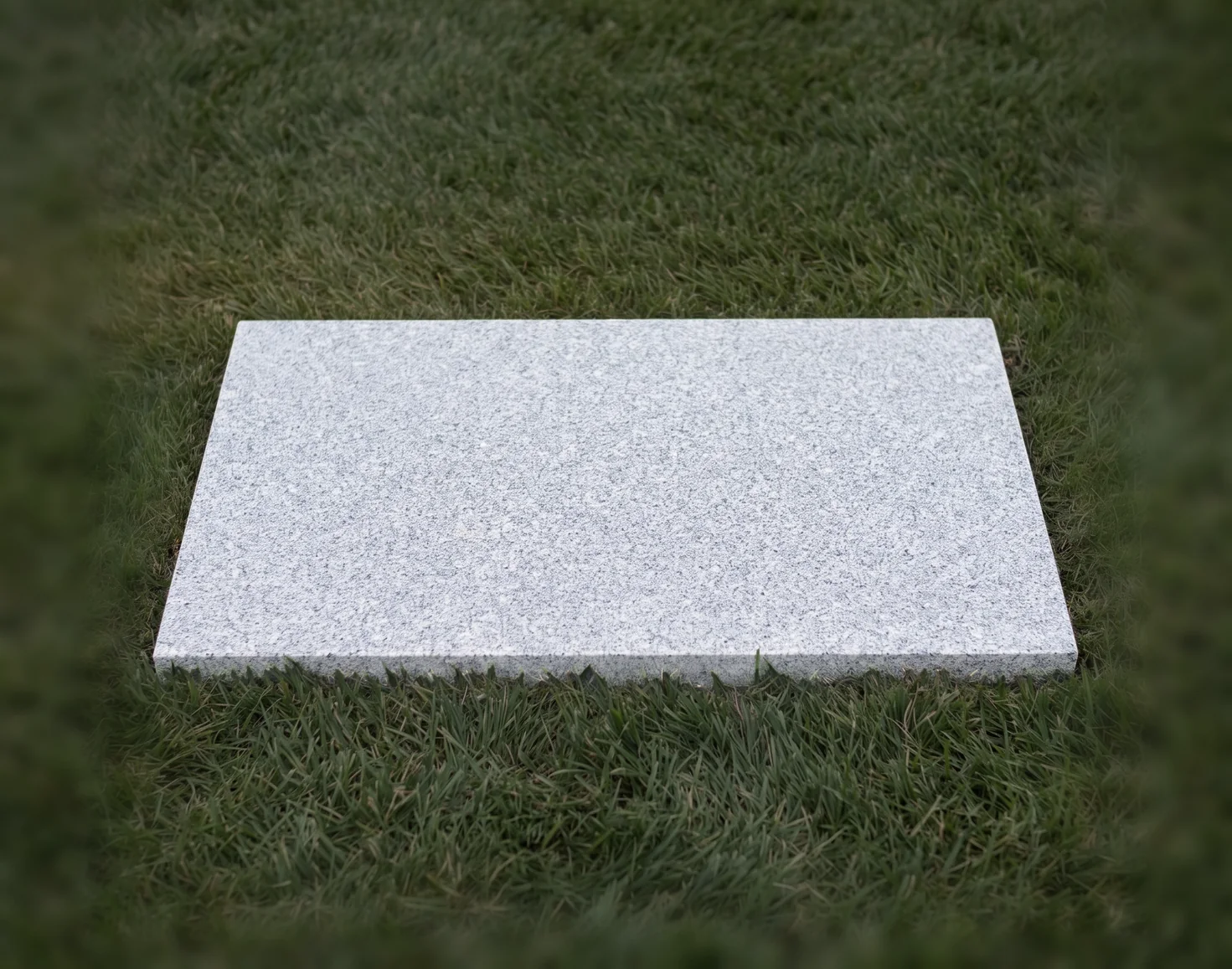
A flat headstone lies level with the grass, so a mower can pass right over it. It is also called a flat marker, a flush marker or a lawn marker.
Flat markers are allowed in more places than any other type. In the rules we read, they were allowed even in sections that turned every other type away. They are made of granite, or of bronze mounted on a base.
The cemetery sets the size. The rules we read asked for single flat markers from about 24 x 12 inches up to 36 x 18 inches, and 4 to 6 inches thick. Our sample is 24 x 12 inches and 4 inches thick: room for a family name, a first name, two dates, a short line and a small symbol. Keep the words short, because people read a flat marker looking down. Sizes, bronze and prices are in our guide to flat grave markers.

Bevel grave markers
A bevel marker is a low granite block that is a little taller at the back than at the front, so the top slopes gently toward you.
One cemetery district we read uses this shape for its cremation section: 24 x 12 inches, 4 inches high at the front and 6 inches at the back. Our sample bevel is 24 x 12 inches and 6 inches tall. Check first, though. Some cemeteries do not allow bevels at all, and flat-only gardens may turn them away.

Slant grave markers
A slant marker has its face cut at an angle, so the names tilt up toward someone standing at the grave. One city’s rules describe it well: a stone “with a gently angled face” that offers “good visibility while keeping a low profile.”
Because it stands above the grass, a slant counts as a raised stone. Flat-only sections do not allow it, and some cemeteries do not allow slants anywhere. Our sample sits on a base and is 24 inches wide, 10 inches deep and 16 inches tall.

Upright headstones and their sizes
An upright headstone is a tablet of granite, called the die, standing on a wider base. It is the stone most people picture, and the names are easy to read from the path.
The cemetery sets upright headstone sizes, usually as a limit on total height and on the length of the base. The rules we read capped a single upright at 36 to 48 inches tall overall, base included, with a base no longer than about 36 to 42 inches. Our sample gray upright is 24 inches wide, 6 inches thick and 30 inches tall.
Uprights belong only in sections that allow raised stones. In a flat-only section, a flat marker is the choice.

Double and companion headstones
A companion headstone is one stone for two people, most often a husband and wife buried side by side. The family name runs across the top, and each person has their own names and dates beneath it. If one of them is still living, their birth date is cut now and the second date is added later. On our sample, Dorothy Jean has only her birth date so far.
There are companion uprights and double flat markers. The rules we read allowed double flat markers from about 48 to 72 inches long, and companion uprights up to 54 to 72 inches long. Our sample companion upright is 36 inches wide, 6 inches thick and 27 inches tall. A double stone usually spans two graves, and one cemetery’s rules size it “by the number and configuration of graves owned on a lot.”

Heart headstones and double hearts
A heart headstone is an upright cut in the shape of a heart. It is a gentle choice for a mother, a wife or a child. The family name sits across the widest part, and a short line of words fits near the point.
A double heart is two hearts joined side by side, one for each person in a couple. Our sample heart is about 24 inches across on a base, and our double heart about 36 inches. Both are raised stones, so they belong in sections that allow uprights.


Bench headstones
A bench headstone is a granite seat with the family name cut into it, so visitors have a place to sit and stay a while. One city’s rules put it simply: “Any bench with a name is considered a monument or memorial.”
Benches go only where the cemetery allows them, and some sections do not. The rules we read allowed about 36 inches long for one grave and 72 inches for two, and one city allows no backs or armrests. Our sample bench has a back about 48 inches wide and 20 inches tall, so ask before you choose a bench with a back.

Pet headstones
A pet headstone is a small marker for a dog, a cat or any animal you loved. It can stand in a garden, a yard or a pet cemetery. A cemetery for people may not take pets: one city’s rules say its lots “are for human burial only.”
Pet stones come flat or upright. Our flat pet marker is black granite, 18 x 12 inches and 3 inches thick, with room for a name, the years, a paw print and a few words. Our pet upright is 12 inches wide, 4 inches thick and 14 inches tall on a base, easier to spot in longer grass. Sizes, prices, burying a pet at home and what to write are in our guide to pet headstones.


Cremation headstones and memorials
Ashes can be remembered in several ways. The cemetery’s rules decide which ones you can use.
- A marker on a cremation grave. Some cemeteries have a cremation section. One we read allows only flush markers there; another uses bevel markers.
- A family grave. Some cemeteries allow a cremation in a grave that already holds a burial, so one stone can serve both.
- A cremation bench. The ashes are stored inside part of the bench, and the names go on the top, front or sides.
- A niche in a columbarium, a wall of small recessed niches that each hold an urn. The name goes on the niche front, cut into granite or on a bronze plate.
- Pedestals and glass-front niches, which some cemeteries offer as well.
VA headstones and markers for veterans
The Department of Veterans Affairs provides a headstone or marker for eligible veterans, and “there is no charge for the headstone or marker itself.” It can mark an unmarked grave anywhere in the world. For a veteran who died on or after November 1, 1990, it can also go on a grave that already has a headstone the family bought, or a bronze medallion can be fixed to that headstone instead.
- Upright headstone in granite or marble, 42 x 13 x 4 inches.
- Flat marker in granite or marble, 24 x 12 x 4 inches.
- Flat bronze marker, 24 x 12 inches. The VA does not supply the base it mounts on.
- Bronze niche marker for a columbarium, 8 1/2 x 5 1/2 inches.
In a private cemetery, placing the stone is “the applicant’s responsibility and all placement costs are at private expense.” Eligibility depends on the discharge and the length of service, and the claim form is VA Form 40-1330. Check the details on va.gov before you order a private stone.
Granite and bronze headstones
Granite is one of the most durable stones used for headstones, and every cemetery rule we read that names a material allows it. Each color takes the lettering differently. On gray granite the cut letters read darker than the face, and they can be shaded dark so they stand out (the ways letters are cut are in headstone fonts). On our black and red samples, the letters read pale against the polished stone. A screen is only a guide to color, so ask to see a sample in daylight.


Bronze markers are cast metal plates mounted on a base. Some cemeteries ask for bronze in certain sections so the markers match. The base matters too: one cemetery requires bronze to sit on a granite base with at least a two-inch border, and another does not allow concrete under bronze at all.
Which is better, a marble or granite headstone?
For a stone meant to last, granite. Marble carves beautifully and has a soft, light look, but the mild acid in rain slowly dissolves marble over time, which can make the letters hard to read. Granite is one of the most durable stones used for headstones. Either way, clean an old stone gently: see how to clean a headstone.
Some cemeteries do not accept marble at all; one city’s rules list marble and limestone as not permitted. Others still allow it, and the VA still offers marble. If you love the look of marble, ask the cemetery first.
How to choose by cemetery rules
Before you settle on a shape, ask the cemetery office for its memorial rules in writing. The rules we read covered:
- Types by section. Some cemeteries allow only flat markers everywhere, others only in certain sections. One city’s memorial park says “all memorials must be flat and flush with the turf.”
- Size. Length, width, thickness and total height, and in several, how many graves the family owns.
- Material. Usually granite or bronze.
- Timing. One cemetery sets stones no sooner than 45 days after a burial, so the grave can settle.
- Approval. Several want to see the design before the stone is made.
Once you know what is allowed, you can design a headstone online in that shape and send the link to your monument company. To see what each type costs, read our guide to headstone cost.
Why do some cemeteries have flat headstones?
Mostly for the look and the upkeep. Flat markers keep a lawn open and even, and a mower can pass straight over them. One cemetery says its marker rules exist “to provide a more uniform and uncluttered appearance and to provide for better and more efficient maintenance practices.”
Is an upright headstone better than a flat headstone?
Neither is better. They do different jobs. An upright is easier to find and to read from the path, and it has more room for words and a symbol. A flat marker is lower and simpler, and it is allowed in more places. If both are allowed, choose the one you would rather visit.
How do you install a flat headstone?
In a cemetery, you usually do not install it yourself. The cemetery or an approved monument company sets it, often on a concrete foundation. One district requires a foundation “constructed by the Cemetery District.” Ask the cemetery who sets stones there before you order.
How much does a granite headstone weigh?
It depends on the size. The VA lists its standard stones this way: an upright headstone of 42 x 13 x 4 inches weighs about 230 pounds, and a flat granite or marble marker of 24 x 12 x 4 inches about 130 pounds. A larger stone on a base weighs much more.
What is a flat tombstone called?
A flat marker or a flush marker; some people say lawn marker or grass marker. One cemetery defines a flush marker as “a flat gravestone set flush to the ground.” Headstone, gravestone, tombstone and grave marker are used for all of these stones, and a monument usually means a larger upright.
Try a type on a stone
Pick any of these shapes, type the names and dates, and see them on the stone as you go. It is free, and there is no account.
Want the steps first? Read how to design a headstone. Wondering about price? See what a headstone costs. Looking for the words? Browse headstone sayings.
Sources
- U.S. Department of Veterans Affairs: Headstones, markers and medallions
- U.S. Department of Veterans Affairs: Types of headstones and markers
- VA.gov: Veterans headstones, markers and medallions (eligibility)
- City of Lawrence, Kansas: Cemetery rules and regulations, revised June 16, 2026
- New Park Cemetery: Rules and regulations
- Calvary Cemetery Association, Dayton, Ohio: Memorial regulations
- Hanford Cemetery District, California: Marker rules
- City of Bellevue, Nebraska: Stone setting specs
- Town of Ridgefield, Connecticut: Cemetery rules and regulations
- Holy Cross Funeral and Cemetery Services, Spokane: Niche burial options
- City of Camrose, Alberta: Valleyview Cemetery brochure
- Wikipedia: Gravestone